Get Started in Digital Electronics with Our Complete Microcontroller Programming Course!

-
Structured Learning
A Modular curriculum covering essential concepts efficiently.
-
Practical
Hands-On exercises and projects to apply learned skills and solidify understanding.
-
Flexible & Interactive
Modules for all skill levels planned to accommodate even full time employees.
Start programming today!
New to programming?
Dive into programming with our engaging and interactive PYTHON course for all skill levels!
Enroll
Course Description
Course Duration: 3 weeks [4 Modules a Week]
Course Objectives:
- Introduce the fundamentals of electronics and C++ programming for embedded systems.
- Provide practical experience through interactive exercises with breadboards & microcontrollers.
- Build a strong foundation in C++ to prepare participants for more advanced topics.
Session Structure:
- Total Sessions per Week: 8 (4 unique sessions, each repeated once)
- Session Duration: 2/4 hours (2 hours per module)
- Modules per Session: 4
Course Schedule:
Week 1:
- Session 1 & 2: Introduction to Python, Basic Syntax, and Data Types
- Session 3 & 4: Control Structures (if statements, loops)
Week 2:
- Session 5 & 6: Functions and Modules
- Session 7 & 8: Data Structures (lists, tuples, dictionaries)
Week 3:
- Session 9 & 10: File & Exception Handling
- Session 11 & 12: Introduction to Object-Oriented Programming.
Sessions Week #1 : Intro | Electronics | Breadboards | Microcontrollers
Module 1: Introduction to Electronics & Embedded Systems
Course Overview & Objectives
- Understanding the course structure and expectations
- Introduction to embedded systems and their applications
Basic Electronic Components
- Overview of resistors, capacitors, diodes, transistors.
- Reading & interpreting electronic schematics.
Module 2: Breadboarding Basics
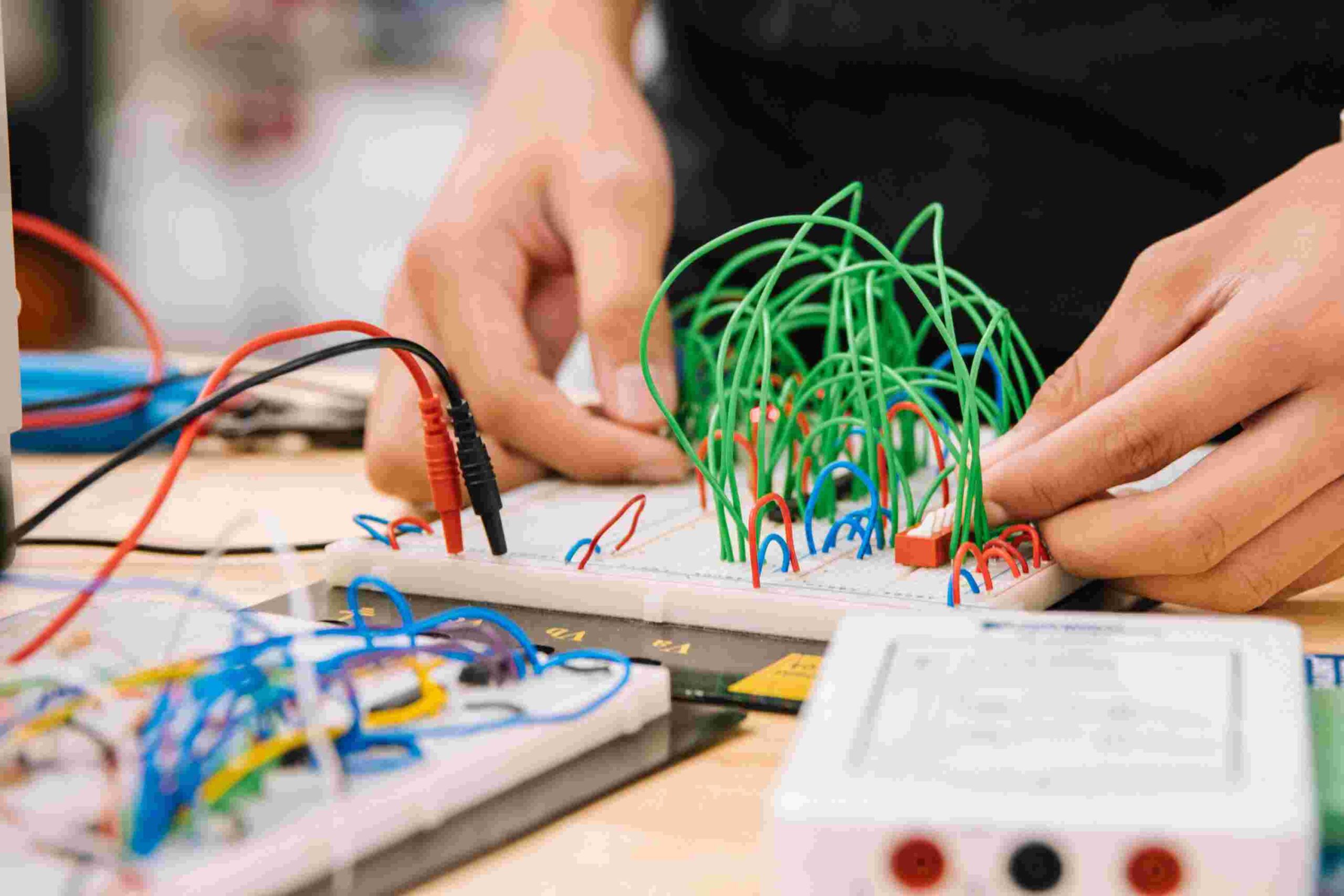
Getting started with a breadboard
- Explanation and usage of a breadboard.
- Creating simple circuits on a breadboard.
Hands-On Breadboarding & 555 Timer IC Prototyping.
- Assembling basic electronic circuits (LEDs, resistors, & switches).
- Prototyping with the 555 Timer IC.
- Troubleshooting & debugging common issues.
Module 3: Introduction to Microcontrollers & Arduino
Introduction to Arduino
- Understanding microcontrollers and their role in embedded systems.
- Getting to know the Arduino hardware.
Arduino IDE Setup & Basics
- Setting up the Arduino IDE
- Writing & uploading your first Arduino sketch.
Module 4: Programming with Arduino (C++)
Basic Programming Concepts
- Variables, data types, and basic operations
- Control structures (if, for, while)
Interfacing with Sensors and Actuators
- Reading sensor inputs (temperature, light sensors)
- Controlling actuators (LEDs, motors)
Sessions Week #2 : Microcontroller Programming
Module 5: Programming with Arduino (C++)
Basic Programming Concepts.
- Variables, data types, & basic operations.
- Control structures (if, for, while).
Interfacing with Sensors and Actuators
- Reading sensor inputs (temperature, light sensors).
- Controlling actuators (LEDs, motors).
Module 6: Functions & Communications
Functions & Libraries.
- Defining & using functions.
- Installing & using Arduino libraries.
Serial Communication
- Understanding & implementing serial communication.
- Building projects involving data transmission.
Module 7: Introduction to MicroPython
Setting Up MicroPython.
- Installing MicroPython on supported devices.
- Writing your first MicroPython script.
Basic Programming with MicroPython.
- Syntax & basic programming concepts in MicroPython.
- Simple projects & hands-on practice.
Module 8: ESP32 DevKit & MicroPython Programming
- Setting up & programming ESP32 with MicroPython.
- Developing IoT applications with ESP32.
Sessions Week #3 : Automation | IoT
Module 9: IoT & Home Automation Applications
Introduction to IoT Concepts
- Basics of IoT & its applications in home automation.
- Overview of IoT architecture & communication protocols.
Hands-On IoT Projects with Arduino
- Creating IoT-based home automation projects using Arduino.
- Monitoring and controlling devices remotely.
Module 10: Hands-On IoT Projects with ESP32
- Creating IoT-based home automation projects using ESP32.
- Integrating sensors and actuators for real-world applications.
Module 11: Capstone Project
Final Project Design & Implementation.
- Designing a simple embedded system using Arduino or ESP32.
- Presenting and documenting your project.


… and begin your journey in programming today!
IT Training | Coding Bootcamps
IT courses & training tailored to individual's specific needs, ensuring gain of valuable skills & knowledge.
STEM Education | Electronics Lab
Engaging projects & sessions on topics like IoT, 3D Mechanical design, electronics & programming for all skill levels.
Modelling | Rapid Prototyping
Maker Space with modern tools & equipment to foster creativity, empowering individuals to turn ideas into tangible products.
Eco - Community DIY Workshops
DIY workshops designed for local communities on building eco-friendly DIY systems to improve their daily lives & businesses.